
The Ultimate Guide to Prague Transportation
I think one of the best things about Prague is its public transport. It’s not something to be intimidated by; it’s a tool that unlocks the city.
It allows you to hop from a cafe in the quiet Vinohrady district to the bustling heart of the Old Town in minutes. It gives you the freedom to explore beyond the areas everyone else walks through.
But I know that first journey can be a point of stress. Figuring out how to get from the airport to your hotel, or wondering if you’re buying the right ticket, can feel complicated. My goal here is to give you a complete, step-by-step guide to all of it.
We’ll start with that first trip into the city, then dive deep into how the daily system works, and finish with some pro tips to make you feel like you’ve been navigating Prague for years.
The First Journey — From Your Arrival Point to Your Accommodation
That first trip sets the tone for your whole visit. Getting it right is a great confidence booster.
Here’s a breakdown of the best ways to get into Prague, depending on where you arrive.
Arriving at Václav Havel Airport (PRG)
After you collect your bags, you have a few good options. Your choice really comes down to your budget and how much convenience you prefer.
Option A: The Budget-Friendly Public Transport Route
This is the cheapest way and the one most locals use. It’s a simple two-step process: bus, then metro.
- Step 1: Buy a ticket. Before you leave the terminal, look for the “PID” (Prague Integrated Transport) counter or the bright orange ticket machines. You’ll need a “90-minute” ticket to be safe. It gives you plenty of time for the journey and any potential delays, so you don’t have to stress. You can pay by card at the machines.
- Step 2: Take the bus to the metro. The main bus to catch is Number 59 (a modern trolleybus). This bus takes you to the Nádraží Veleslavín station, which is the start of the Metro Line A (Green). This line is perfect if you’re staying in popular areas like the Old Town (Staroměstská), Malá Strana (Malostranská), or Vinohrady (Náměstí Míru).
- The Most Important Step: Validate your ticket. The moment you get on the bus, you must stamp your paper ticket in one of the yellow validation boxes. You will hear it make a little printing noise. This time-stamps your ticket and starts the 90-minute clock. You only do this once. Do not stamp it again when you transfer to the metro.
Option B: The Airport Express (AE) Bus
This is a good middle-ground option. The AE bus is a dedicated line that travels directly from the airport terminals to the Main Train Station (Hlavní nádraží) in the city center.
- How it works: You buy a specific AE ticket directly from the driver (card or cash) or at the counter. Your regular public transport ticket is not valid on this bus.
- Who it’s for: This is a great choice if your hotel is near the train station or if you need to catch a connecting train out of Prague.
Option C: Ride-Sharing Apps (Uber/Bolt)
For pure door-to-door convenience, this is your best bet. Uber and Bolt are both widely used and reliable in Prague.
- How it works: You use the app just like you would at home. After you book, follow the signs inside the terminal for the designated pickup zones, which are usually in the P1 parking building.
- The benefit: You see the price upfront in the app, so there are no surprises. It’s especially practical if you’re traveling with heavy luggage or in a small group.
Option D: Official Airport Taxis
If you prefer a traditional taxi, my strong advice is to only use the official airport partners. You can find their booking counters (like FIX TAXI) inside the arrivals hall. This way, you get a regulated fare. I would strongly advise against accepting a ride from any driver who approaches you directly in the terminal.
Arriving by Train or Bus
If you’re arriving by land, you’re in luck because the main stations are already perfectly connected.
- Hlavní nádraží (Main Train Station): You’ll arrive directly on the Metro Line C (Red). From here, you’re just a short metro ride or a pleasant walk from the city center.
- Florenc Bus Station: This is another major hub, with access to both Metro Line B (Yellow) and Metro Line C (Red), making your onward journey very simple.
Prague Integrated Transport (PID)
Once you’re settled in, the public transport system, known as PID, will become your best friend. The best way to think about it is as one big, unified network. You don’t need to worry about separate tickets for different kinds of transport.
One Ticket to Rule Them All
The core idea is simple: a single ticket, once validated, works for a specific amount of time on almost everything. You can jump from a metro to a tram and then to a bus, all on the same ticket, as long as you’re within your time limit. This makes getting around incredibly straightforward once you understand the basics.
The Trinity of Prague Transport
You’ll mostly be using three modes of transport. Each has its own strengths.
1. The Metro: The Backbone of the City
For covering longer distances quickly, the metro is unbeatable. It’s clean, fast, and easy to navigate. There are three lines, each identified by a color and a letter:
- Line A (Green): This will likely be your most-used line. It cuts through the historical heart of the city, connecting you to key spots like the Prague Castle area (Malostranská), the Old Town (Staroměstská), and Wenceslas Square (Můstek).
- Line B (Yellow): This line runs from east to west and is useful for reaching areas like the Florenc bus station or the Anděl shopping district.
- Line C (Red): Running north to south, this line connects the Main Train Station (Hlavní nádraží) and the historic Vyšehrad fortress.
The metro runs from roughly 5:00 AM until midnight, with trains coming every few minutes during peak hours.
2. Trams: The Scenic Way to Travel
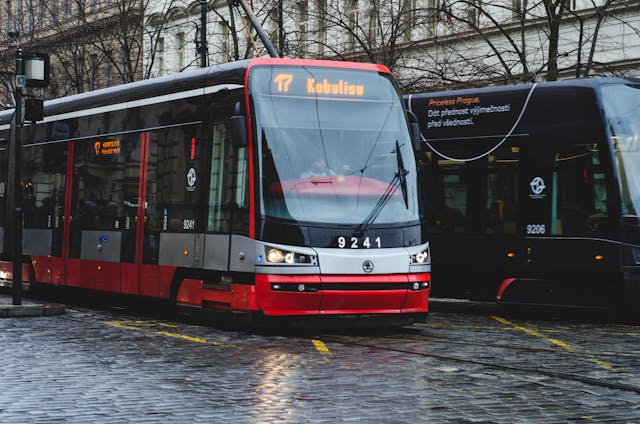
I think the trams are the real soul of Prague’s transport. Because they run at street level, you get a mini-sightseeing tour every time you ride one. They are perfect for shorter trips or when you’re not in a rush.
- Iconic Routes: If you want a great tour for the price of a transport ticket, I recommend Tram 22. It winds its way through some of the most beautiful parts of the city, passing the National Theatre, climbing up to the Prague Castle complex, and heading into quieter neighborhoods. Tram 17 is another favorite of mine, as it follows the path of the Vltava river, offering wonderful views.
- Night Trams: After the metro and daytime trams stop around midnight, a network of night trams (with numbers in the 90s, like 92, 94, etc.) takes over. They all converge at the central Lazarská stop, making it easy to transfer. They run all night, so you always have a way to get back.
3. Buses: Connecting the Outer Areas
As a tourist staying in the city center, you might not use buses very often. Their main job is to connect the outer neighborhoods to the tram and metro lines. The one exception is your trip from the airport, as we already covered.
The Ticket Bible: Everything You Need to Know to Avoid Fines
This is the most important section. Understanding the tickets is the key to a stress-free experience.
A Breakdown of Ticket Options
You have two main types of tickets: short-term tickets and longer-term passes.
- 30-Minute Ticket: Good for a very short, direct trip.
- 90-Minute Ticket: This is the most flexible short-term option. I recommend it for any single journey that involves a transfer, like your trip from the airport.
- 24-Hour Pass: Perfect for a full day of sightseeing.
- 72-Hour (3-Day) Pass: If you’re here for a weekend or a short trip, this is almost always the best value. You buy it once, validate it once, and then you don’t have to think about tickets for the rest of your stay.
THE VALIDATION RITUAL: A Step-by-Step Guide
This is the one thing you absolutely must get right. An un-validated ticket is the same as no ticket.
- After you buy your paper ticket, find the yellow or orange validation boxes. They are located at the entrance to all metro stations (before you go down the escalators) and inside every tram and bus.
- Insert your ticket into the slot, arrow-side first.
- You will hear a distinct cha-chunk sound as the machine prints the date and time on it. This starts your ticket’s clock.
- You only do this once. The very first time you use a ticket or pass, you validate it. After that, you just keep it with you. Do not stamp it again on your next ride. Stamping it a second time will make it invalid.
Where and How to Buy Your Tickets
You have several convenient options:
- Ticket Machines: These are the large orange machines at all metro stations and some tram stops. They take coins and, in most cases, contactless cards.
- The “Lítačka” App: This is the official app for Prague transport. You can buy tickets and passes directly on your phone. A key point: you must “activate” the ticket in the app a couple of minutes before you board, so you can’t just buy it as the tram is arriving.
- Contactless Terminals (Inside Trams and Buses): Many trams and buses now have an orange contactless terminal inside. You can simply tap your bank card to buy a single ticket. The screen will confirm your purchase. This is very convenient for a one-off trip.
- Newsstands/Tabák Shops: Many small convenience stores and newsstands sell tickets.
Beyond the PID — Other Ways to Get Around
While the public transport system is fantastic, there will be times when you need or want a different option.
Sometimes, the best way to travel is on your own two feet, and other times, you just need the convenience of a car.
Walking: The Best Way to Discover Prague’s Soul
I honestly believe the best way to experience the historic center of Prague is by walking. This is how you discover the quiet courtyards, the hidden alleyways, and the small, independent shops that you would completely miss on a tram or metro.
The core of the city, from the Castle, across Charles Bridge, through the Old Town, and into the Jewish Quarter is a walker’s paradise.
The Cobblestone Reality: A Word on Your Feet
This is my single most important piece of advice for anyone visiting Prague: bring comfortable, sturdy shoes. The city’s beauty is built on centuries-old cobblestones. They are charming to look at but can be very tiring and unforgiving on your feet, especially if you’re wearing thin-soled shoes.
Prioritizing comfort will have a huge impact on how much you enjoy your time here. It’s also worth noting that the uneven surfaces can present challenges for anyone with mobility concerns.
Ride-Sharing & Taxis: The Rules of the Road
There will be moments when you need a car, perhaps heading to a restaurant in another neighborhood late at night or getting back to your hotel after a long day of walking.
Apps Are Your Friend
By far, the most reliable and transparent way to get a car is by using a ride-sharing app on your phone.
- Uber and Bolt are the dominant players and work exactly as you’d expect. You see the fare upfront, you can track your driver, and the payment is handled securely through the app. There are no language barrier issues with explaining your destination and no worries about the meter.
- Liftago is a great local alternative. It’s an app that works with licensed taxi drivers, so you get the professionalism of a traditional taxi with the convenience of an app.
The Golden Rules for Taxis
Prague’s reputation with taxis has improved, but you still need to be cautious, especially in tourist-heavy areas. If you need to use a traditional taxi, I live by these simple rules:
- Rule #1: NEVER hail a cab from a tourist square or a train station. This is where you are most likely to be overcharged. Drivers waiting in these spots often rely on visitors who don’t know the proper rates.
- Rule #2: If you need a taxi, call a reputable company. Ask your hotel reception or a restaurant to call one for you. Companies like AAA Taxi have a long-standing reputation for being reliable.
- A Few Red Flags to Watch For: Be wary of any taxi without clear company branding on its roof and doors. Be cautious of drivers who offer a flat rate for a city trip, it is almost always higher than what the meter would show. A running meter is your friend, as long as it’s not running suspiciously fast. Using an app avoids all of these worries entirely.
Now that you know how to get around, let’s talk about the tools and the unwritten rules that will make every journey easier.
Think of this as your final preparation for navigating the city with complete confidence.
Digital Tools: Your Pocket Navigators
A few apps on your phone can take all the guesswork out of your travels.
- Google Maps: This is probably the app you already have, and it works wonderfully in Prague. It’s fully integrated with the PID system, giving you real-time information on tram and metro schedules, transfer points, and walking directions. For most situations, it’s all you’ll need.
- IDOS: This is the local’s choice and the official journey planner for all public transport in the Czech Republic. While Google Maps is simpler for basic A-to-B trips, IDOS is more powerful for finding complex connections or looking up detailed timetables. It’s a great tool if you plan on taking any day trips out of the city by train or bus.
- Lítačka: As mentioned earlier, this is the official PID app. Its primary function is for buying and managing your tickets digitally, which can save you the hassle of finding a ticket machine.
Understanding the Rules & Etiquette
Knowing a few social customs will help you blend in and keep the system running smoothly for everyone.
Meeting the Ticket Inspectors (Revizoři)
You will see ticket inspections happen. It’s a normal part of the honor system. Here’s what you need to know:
- Who they are: Inspectors are usually in plain clothes. They will approach you and discreetly show you a metal badge with their identification. The process is very official and calm.
- What to do: Simply show them your validated paper ticket, or the active ticket on your Lítačka app.
- If you made a mistake: If you forgot to validate your ticket or it has expired, you will be fined on the spot. Arguing will not help. The fines are steep, so it’s a powerful reminder of why the validation step is so important. As long as you have a properly validated ticket, an inspection is a quick, non-eventful process.
Unspoken Social Rules
These are the small things that show you’re a considerate traveler:
- On Escalators: Always stand on the right side. The left side is treated as a passing lane for people in a hurry.
- Boarding Trams and Metros: Stand to the sides of the doors and let everyone who is getting off exit before you try to board. It makes the whole process faster and less chaotic.
- Giving Up Your Seat: It is a strong and widely practiced custom to offer your seat to the elderly, pregnant women, people with disabilities, or parents with very young children.
- Keep the Volume Down: Loud conversations and phone calls are generally avoided on public transport. People appreciate a quiet and calm commute.
Travel with Confidence
Prague’s transport system might seem to have a lot of rules at first, but once you spend a day here, you’ll realize how logical and efficient it is.
It’s a system designed to make exploring this wonderful city easy and affordable.
If you remember just three things from this guide, make it these:
- Always validate your ticket the very first time you use it.
- Use apps like Uber or Bolt if you need a taxi to ensure a fair price.
- Wear your most comfortable shoes your feet will thank you.
With this knowledge, you are more than prepared. You have the tools to get from the airport to your hotel, to master the trams and metro, and to travel around the city with the ease of a local. Now you can focus on the important part: enjoying everything Prague has to offer.